The short answer
Move to Nano Banana 2.1. Google deprecated Nano Banana 2 on 6 October, the day it made Nano Banana 2.1 generally available, and recommends the new model for all new projects; it hasn't announced a shutdown date. In our edit test Nano Banana 2.1 cost $0.037 an edit against $0.068 for Nano Banana 2, and kept the rest of the picture no better and no worse. After seven small edits, each ending "Change nothing else in the image", both had left almost none of the untouched area as it was, 3% and 5%, where FLUX 3 Image kept 93% in our run of 3 October.
How much of the untouched picture each model keeps, and what an edit costs
Share of the pixels no instruction touched that stay within one just-noticeable difference of the original, averaged over three pictures; outlined after one edit, filled after seven. Right: cost per edit
Google also says the new model keeps a character more consistent across turns. With a fresh call for each edit we saw no difference: the woman in our portrait drifted the same way on both models, to a face similarity of 0.67 and 0.66 after eight edits. Making the same edits in one conversation, the way Google recommends, kept her closer on both: Nano Banana 2.1 ended at 0.83 and 0.79 in two runs, Nano Banana 2 at 0.79.
Editing in a conversation also brought two faults the fresh calls didn't show. On the bakery's chalkboard, the word next to the price we changed came out misspelled in every conversation run on both models, and in one of the 12 conversation chains Nano Banana 2 went back to editing the original photo. This is one fresh-call run and two conversation runs, on three pictures, at default settings.
What Google changed
On 6 October Google made Nano Banana 2.1 generally available and, in the same release note, deprecated Nano Banana 2 "(no shutdown date announced)", telling developers to migrate. Its image-generation guide now calls Nano Banana 2 the previous generation and says "Recommended for all new projects to use Nano Banana 2.1."
Google describes the new model as "an update to Nano Banana 2" and lists improvements in "visual quality, prompt adherence, multi-turn character consistency, text rendering, and wide and panoramic aspect ratio generation". Its price for an image at the size our edits came back in is $0.0336 on Nano Banana 2.1 and $0.067 on Nano Banana 2.
The same guide says "Multi-turn conversation is the recommended way to iterate on images", and that you can "Conversationally define a "mask" to edit a specific part of an image while leaving the rest untouched." Our test measures whether the rest does stay untouched.
What we measured
We reused the protocol from our first edit test. There are three pictures, made by a different model so that no model edits its own work: a woman at a desk, a bottle of serum with props around it, and a Berlin bakery front with a sign and a chalkboard. Each gets eight instructions in a row, each naming one region and ending "Change nothing else in the image." After every edit we compare the picture with the original, looking only at the area no instruction has touched so far, and count the share of its pixels whose colour is within one just-noticeable difference of the original. Face recognition scores the woman's face against the original. Text is read by OCR, and every line the OCR flags is then read by eye.
On 8 October we ran Nano Banana 2.1, Nano Banana 2 and Nano Banana Pro that way, with a fresh call for each edit that carried only the last picture, all three served by Google AI Studio through OpenRouter. Then, late on 8 October, with the second run ending just after midnight, we ran Nano Banana 2.1 and Nano Banana 2 twice more with all eight edits in one conversation, through Google's own SDK on Vertex AI, which sends every earlier instruction and picture along with each new one. The protocol was written down before the first paid call of each run and was the same in all of them apart from how a turn was sent. The fresh-call run cost $6.04 and the two conversation runs $5.53.
Nano Banana 2.1 keeps no more of the picture than Nano Banana 2
With fresh calls, Nano Banana 2.1 kept 66% of the untouched area unchanged after one edit, on average over the three pictures, and Nano Banana 2 kept 65%. After four edits it was 15% and 14%, after seven 3% and 5%. Over all twenty-four edits the average was 22% for both models, and they swapped places from one edit and picture to the next. Nano Banana Pro, at $0.136 an edit, did no better: 66% after one edit and 4% after seven. None of them moved the frame, so the change is repainting, not a shifted picture.
Every run, after one, four and eight edits
Share of the untouched area within one just-noticeable difference of the original: portrait / product shot / shopfront
| model | how the edits were sent | after one edit | after four | after eight |
|---|---|---|---|---|
| Nano Banana 2.1 | fresh calls | 69% / 88% / 39% | 16% / 21% / 9% | 2% / 3% / 4% |
| Nano Banana 2 | fresh calls | 69% / 87% / 39% | 13% / 17% / 11% | 2% / 3% / 5% |
| Nano Banana Pro | fresh calls | 70% / 89% / 38% | 17% / 25% / 11% | 3% / 3% / 5% |
| Nano Banana 2.1 | conversation, first run | 68% / 86% / 38% | 19% / 18% / 12% | 4% / 3% / 5% |
| Nano Banana 2.1 | conversation, second run | 68% / 87% / 38% | 17% / 21% / 13% | 4% / 3% / 6% |
| Nano Banana 2 | conversation, first run | 69% / 87% / 38% | 21% / 2% / 12% | 5% / 3% / 5% |
| Nano Banana 2 | conversation, second run | 69% / 85% / 38% | undone / 18% / 12% | undone / 3% / 5% |
With fresh calls, all three did every edit they were asked for, 24 of 24 each, and broke the same text at the same points. The serum label read "Night Sorum" from the first edit on every model, and the price change on the chalkboard, the fourth edit, redrew the whole board, leaving a malformed euro sign on a line nobody asked to change. The shop sign came through intact every time.
Where the text first broke
Read by eye against the original, edit by edit
| run | serum label | chalkboard, a line nobody asked to change | “Kaffee” drawn “Kuffee” | shop sign |
|---|---|---|---|---|
| Nano Banana 2.1, fresh calls | first edit | fourth edit | never (smudged by the eighth edit) | intact |
| Nano Banana 2, fresh calls | first edit | fourth edit | never (smudged by the eighth edit) | intact |
| Nano Banana 2.1, conversation, first run | first edit | fourth edit | from the fourth edit | intact |
| Nano Banana 2, conversation, first run | first edit | fourth edit | from the fourth edit | intact |
| Nano Banana 2.1, conversation, second run | first edit | third edit, before the price change | from the third edit | intact |
| Nano Banana 2, conversation, second run | second edit | fourth edit | from the fifth edit | intact |
On 9 October the leaderboards preferred Nano Banana 2.1 by a clear margin
On Artificial Analysis's image-editing board, read on 9 October, Nano Banana 2.1 was #4 with an Elo of 1137 and Nano Banana 2 was #10 with 1110. Their 95% intervals, 1128 to 1146 and 1102 to 1118, don't overlap. On the text-to-image board they were #4 and #7.
That doesn't contradict our result. The editing board's Elo comes from votes between two edits of the same picture made from the same instruction, so it rates the result of one edit. Our test counts what else changed over eight edits in a row. Nano Banana 2.1's edits can look better and still repaint as much of the picture as Nano Banana 2's, and we didn't measure how good the edits look.
The two models side by side
Cost and face similarity are our runs; places and Elo are Artificial Analysis's, read 9 October 2026; list prices are Google's
| model | cost per edit | Google's list price per image | editing board | text-to-image board | face after eight edits, fresh calls | face after eight edits, conversation |
|---|---|---|---|---|---|---|
| Nano Banana 2.1 | $0.037 | $0.0336 | #4, Elo 1137 | #4, Elo 1160 | 0.67 | 0.83 and 0.79 |
| Nano Banana 2 | $0.068 | $0.067 | #10, Elo 1110 | #7, Elo 1126 | 0.66 | 0.79 (first run only) |
In one conversation, the face stayed closer to the original
The woman's face, after one edit and after eight
Face similarity to the original (SFace cosine, where one means identical); outlined after one edit, filled after eight
With fresh calls the woman's face drifted at the same rate on both models: her similarity to the original went from 0.97 to 0.67 on Nano Banana 2.1 and from 0.96 to 0.66 on Nano Banana 2. In a conversation, Nano Banana 2.1 ended at 0.83 and 0.79 in the two runs, and Nano Banana 2 at 0.79 in the first run. Its second-run portrait doesn't count, for the reason in the next section. She stayed above 0.363, the same-person threshold our protocol takes from OpenCV for this recogniser, in every chain.
The same eight edits, sent two ways
Nano Banana 2.1, the face in the portrait, with fresh calls and in one conversation
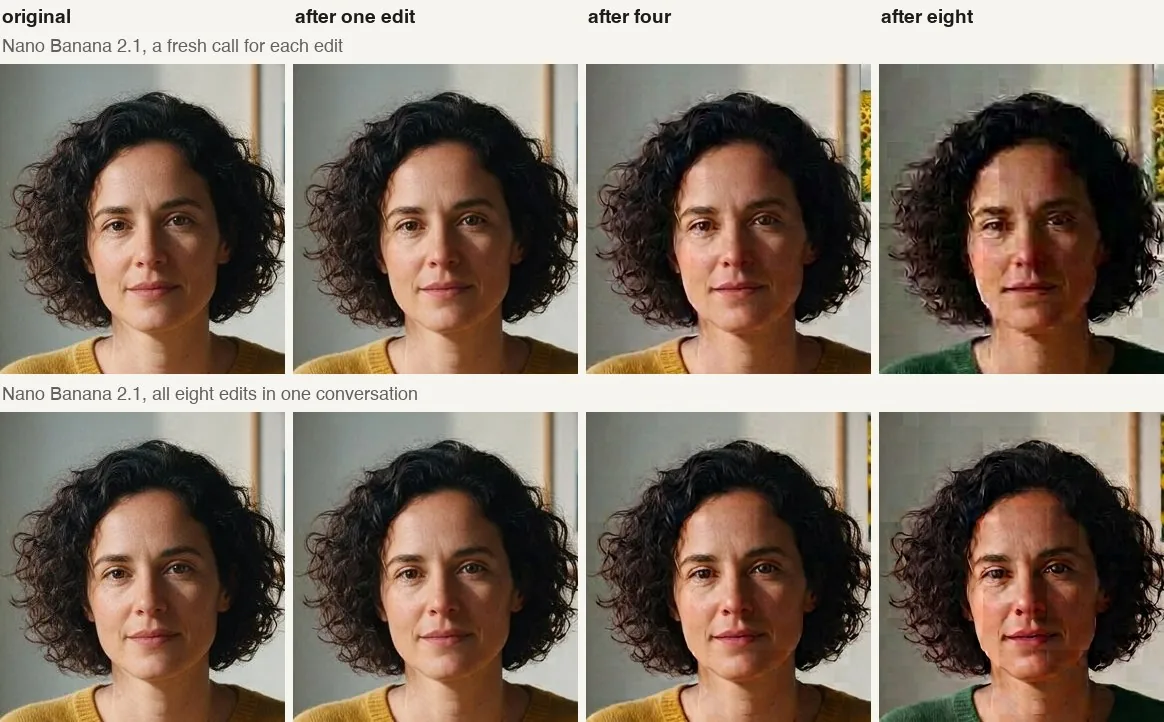
The conversation didn't help the rest of the picture. After eight edits in a conversation Nano Banana 2.1 had kept 4% of the untouched area in one run and 4% in the other, against 3% with fresh calls. The two modes also ran on different routes, Vertex AI against Google AI Studio through OpenRouter. The first edit is the same request in both modes, and there the two agreed within 2.2 points on every picture, so the route doesn't account for the difference in the face.
What went wrong in a conversation
On the chalkboard, the "a" in "Kaffee", on the line whose price we changed, came out as a "u" in all four conversation chains of the bakery picture: "Kuffee". On Nano Banana 2.1 it appeared at the fourth edit in one run and at the third in the other, before the price change had been asked for. On Nano Banana 2 it appeared at the fourth and at the fifth. With fresh calls the eye check read "Kaffee" on both models, though by the eighth edit the word is smudged. The new price itself came out right every time.
“Kaffee” becomes “Kuffee”
Nano Banana 2.1, the word Kaffee on the chalkboard

In the second conversation run, Nano Banana 2's portrait stopped building on its own pictures. From the second edit on, each turn returned the original photo with roughly that turn's change applied: the mug went back to white, the sunflower print back to mountains, and of the earlier changes only the red lamp stayed. Of the 24 earlier edits we could test on that chain, it had undone 24. Its bakery chain in the same run undid the blue door (7 of 28 tests). No other chain undid anything: 0 of 159 in the first conversation run, 0 of 78 for Nano Banana 2.1 in the second, and 0 of 165 with fresh calls.
A conversation that went back to the original photo
Second conversation run, the portrait, on Nano Banana 2.1 and Nano Banana 2
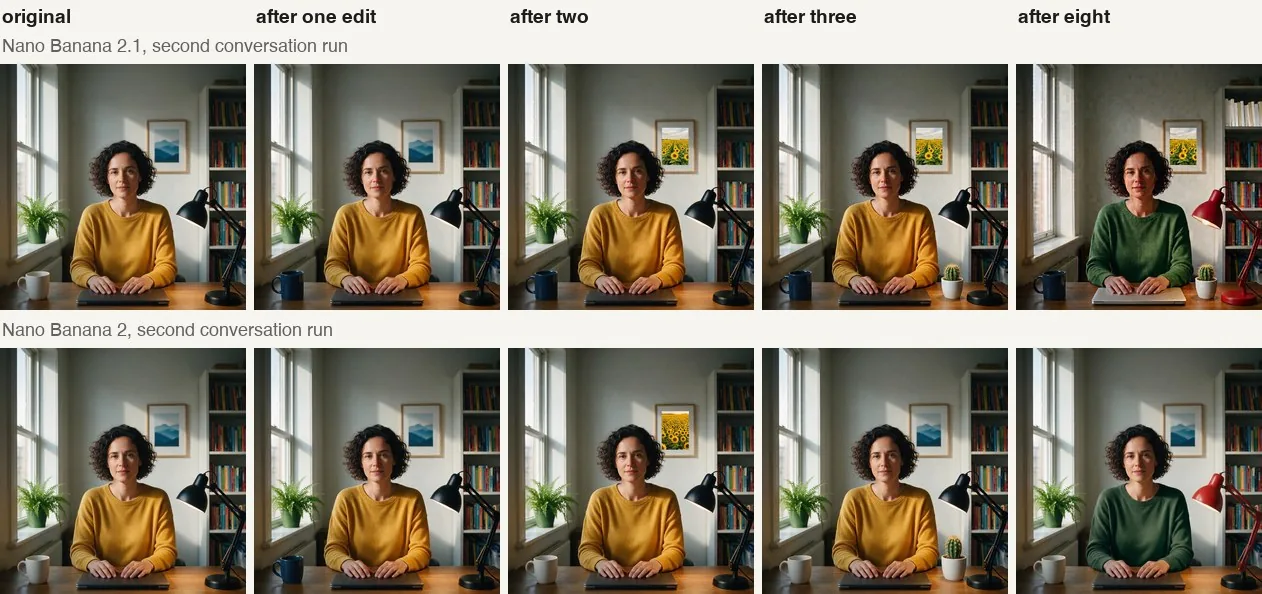
Our scorer compares every picture with the original, so a chain that throws its edits away scores as if it had kept the picture perfectly. We left that portrait chain out of the face figures and marked it in the table. A conversation keeps the original photo in its history, so "Edit this image" can be read as "edit the original". We kept the instruction as written on purpose. An instruction that names the last picture might stop the reverting, and we haven't tested one.
In the first run, Nano Banana 2 also repainted the whole wall behind the serum at the second edit, and in the second run it didn't. Two of the 12 conversation chains went wrong as a whole in a way the averages don't show, so a conversation's results need checking picture by picture.
If you're on Nano Banana 2
Move to Nano Banana 2.1. In our test it kept the picture as well as Nano Banana 2 did, at 55% of the cost per edit, and voters on Artificial Analysis's boards preferred its results when we read them on 9 October.
If you make several edits to a picture of a person, making them in one conversation kept her face closer to the original on both models. It didn't keep more of the rest of the picture.
Read any text near an edit at full size before you use the picture. That applies with fresh calls too, since the label and the chalkboard broke in every chain.
In a conversation, check that each new picture still has the earlier changes in it.
If the rest of the picture has to stay as it was, neither Nano Banana does that in our test. FLUX 3 Image kept 93% of the untouched area after seven edits in our run of 3 October, at $0.025 an edit. It skipped the one edit that asked for new text, the price change, and its average fell to 65% at the eighth edit, when the eighth instruction for the product shot turned the whole wall behind the serum blue.
What these runs can't tell you
Two runs of the same thing differ. Nano Banana Pro's fresh-call runs on 3 October and 8 October differed by up to 7.4 points on one picture at one edit. A difference between the two models smaller than that isn't a finding, so a small real gain in Nano Banana 2.1 would be hidden here. This test only rules out a large one.
Nano Banana 2.1's two conversation runs agreed within 4.6 points on the untouched area and 0.04 on face similarity. One reverted chain among 6 for Nano Banana 2, and none among 6 for Nano Banana 2.1, is too few to say the new model is safer from it.
It is three pictures, eight edits each, every model at its default settings with a plain instruction and no seed. The conversation runs went through Vertex AI and returned PNG files; the fresh calls went through OpenRouter to Google AI Studio and returned JPEG. We measured how much of the picture each model keeps, not whether its edits look good.